
To chat or not to chat
The Return to the Default

The man from London I talked about in my last newsletter, the one who caused fifty highly accomplished CEOs to pull out their phones and record a demonstration like teenagers recording a Taylor Swift concert, said something after his demonstration that I have been unable to stop thinking about.
He said the chat interface is a hundred times better than any website will ever be. That made me think.
I build digital products. My company designs interfaces. If the chat layer replaces the UI layer, a meaningful portion of what we do becomes a question I would rather not answer before coffee.
So I sat with the discomfort for a few days and tried to determine whether it was the discomfort of hearing something wrong or the discomfort of hearing something true.
I think it is true. Not for everything. But for a category of tasks that is growing larger than I had previously spent the time to admit.
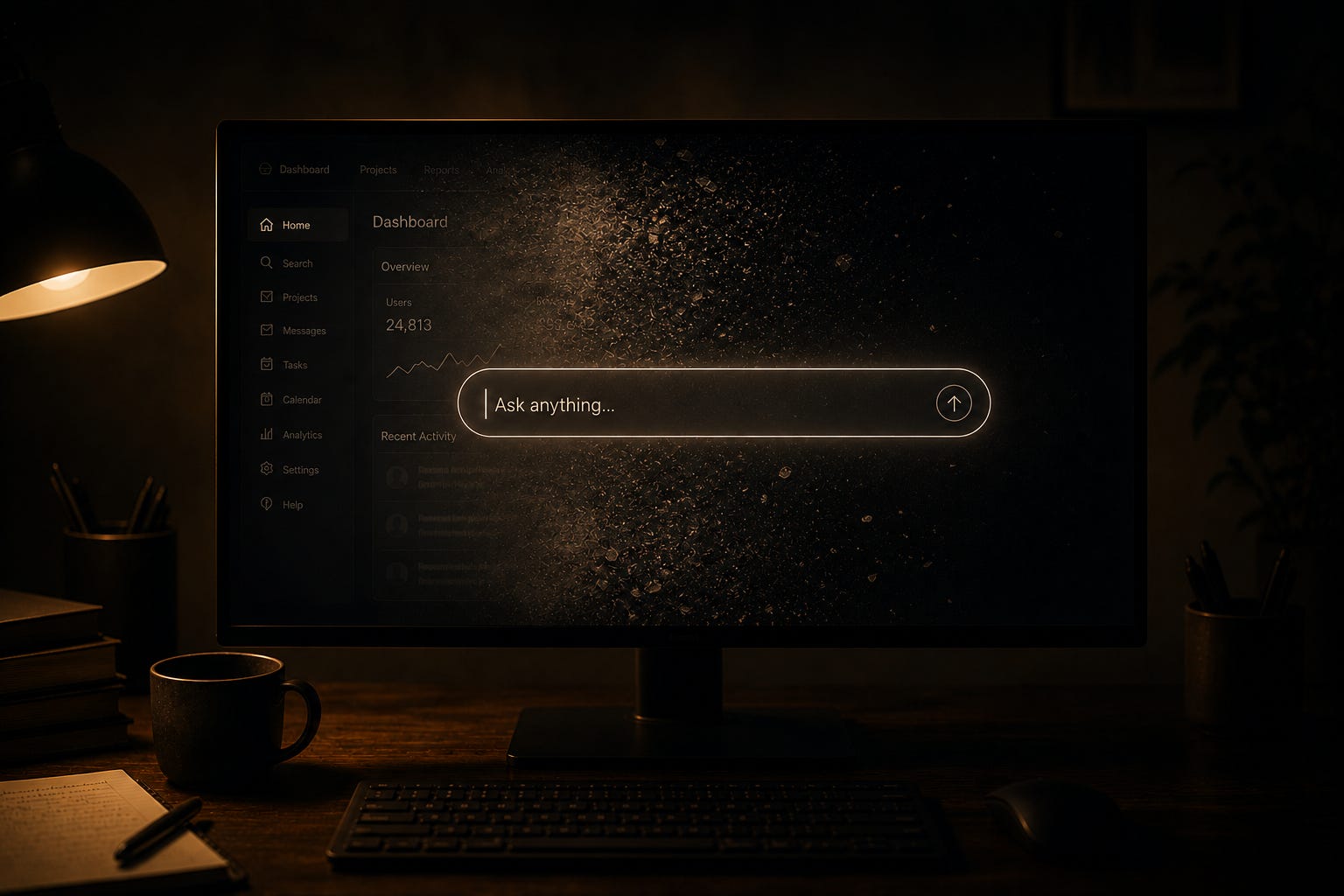
The Return to the Default
Think about what the man from London actually did. A reminder or to set the stage: He had a specific need: book a Speaker on a particular theme, within a particular budget, with particular travel constraints, for a particular type of event. A website offered him ten thousand options and a set of filters that could not capture the specificity of what he wanted. But a chat interface lets him describe exactly what he needs in a sentence and receive a curated answer in thirty seconds.
Yet what he really did was not adopt a new technology; he brought back an old one. The oldest one, actually. Conversation.
I am not clicking buttons to communicate with you right now. I am not navigating a menu to convey a thought. I am using language, which is the tool human beings have employed to solve problems and exchange information since before we had writing, before we had screens, before we had anything at all except proximity and something to figure out.
The chat layer in software is not, I think, an innovation.
It is a correction.
We spent three decades building elaborate visual systems to give humans access to powerful engines. Menus, toolbars, dropdowns, filters, dashboards, settings panels, nested navigation. These were the best solutions available at the time for translating human intent into machine action. They were also, in retrospect, workarounds. Accommodations for the fact that machines could not understand natural language, and so humans had to learn to speak in clicks.
Now the machines can understand natural language. Or at least process it well enough that the distinction, for practical purposes, has collapsed. And it turns out that when you give people the option to interact with software by describing what they want in their own words, they prefer it. Not for everything. But for tasks where the question is complex, the need is specific, and no dropdown menu arrangement can capture the full dimensionality of what the person is actually looking for.
What the Big Companies Already Know
Adobe just released a protocol that connects its entire product suite to a conversational AI. You can now resize a photograph, transform an image, adjust a layout, and apply effects by describing what you want in plain language. The menus, of course, still exist. The toolbars are still there. But the company has built a parallel path, a conversational path, and the message is unmistakable: we believe a significant number of our users would rather talk to our product than click through it.

Meta (it’s still Facebook, no matter the rebrand IMO) launched a similar protocol for managing advertising campaigns. The campaign manager interface, with its targeting options, budget sliders, and audience segments, is not going away. But you can now accomplish the same tasks through conversation.
A majority of the commentary I have read about this so far has treated this as a kind of surrender, as if these companies had looked at their beautifully designed interfaces and thrown up their hands.
But I think that kind of misses the point.
Because what it really proves is that the interface of any product was never the product. The product was always the engine underneath: the capability to process, transform, analyze, filter, route, optimize.
The interface, it turns out, was/is nothing but the wrapping paper. And for a while, it was the best wrapping paper available at the time, built with enormous skill and care, but wrapping paper nonetheless. A way of giving humans access to the engine using the input methods humans had: mice, keyboards, touchscreens, and taps.
Now humans have a different input method.
Language.
And language, it turns out, is what we were reaching for all along.
Think about it. Every search bar was an attempt at conversation. Every filter was an attempt to describe a need. Every support chatbot, however rudimentary, was an acknowledgment that some problems are better solved by talking than by clicking.
So the companies releasing these protocols are not surrendering their interfaces. They are admitting that the interface was, for a large category of tasks, the wrong answer to the right question.
Where Conversation Wins (and Where It Does Not)
But the chat layer only wins when the user knows what they want, but not where to find it. When the need is specific enough that filters cannot capture it.
“Find me a speaker on resilience for under $5,000 who does not need to cross an ocean.”
“Give me a breakdown of ad performance for this campaign, grouped by creative and sorted by cost per acquisition.”
“Show me which of my clients had the highest engagement drop-off last month and suggest three possible reasons.”
These are not queries. They are conversations. They have always been conversations. We only forced them into interfaces because the interfaces were all we had. Now we have something better, and the something better is the thing we were doing anyway every time we turned to a colleague and said, “Hey, can you pull that report for me?” or “Can you make that more pink?”
But that doesn’t mean that the visual layer goes away.
We are, as humans, a very visual species.
Thus, the visual layer wins when the user wants to browse, explore, or experience.
I want to see the class schedule for next week. I do not want to be told it.
I also want to look at my bank balance and browse a menu.
I want to scroll through products and let something catch my eye.
These things are not conversations. They are experiences. And experiences require visual space, layout, imagery, the kind of sensory engagement that a text-based conversation cannot provide.
What This Means for the Products We Build
I came home from Chicago and looked at my own products differently. We build digital tools. Booking systems, membership platforms, lead conversion flows. They have interfaces. Buttons, screens, forms, dashboards. The traditional apparatus.
I am now asking a question about each of those products that I was not asking two weeks ago: which of these tasks should be a conversation?
The booking screen, where a customer browses classes and picks a time, should probably remain visual. That is an experience. You want to see what is available, feel the rhythm of the schedule, and choose from what is presented. Conversation adds friction there, not value.
But the back-end reporting, where you want to know which location had the most cancellations last month and why, should almost certainly be a conversation. Right now, that is a dashboard with filters. It should be a question asked in plain language with an answer delivered in plain language. The dashboard can still exist for the person who wants to explore. But the conversation should exist for the person who wants to know.
And in every case, in every product, for every interaction, I am now thinking about where the eggs go. Where is the moment of human participation that makes the output feel owned? Where is the small manual step that converts “the machine did this” into “I made this, with help”?
This is the design challenge of the next five years. Not building the chat layer. That part is becoming straightforward. The challenge is knowing which interface to use for what. And that, like most things worth getting right, requires the kind of judgment that no amount of conversational AI can replace.
Until next Wednesday,
Ashley Heron
Managing Director, Comma Eight